
Structural Engineering — Structural Dynamics
Natural frequency, vibration response (harmonic magnification), and seismic response (base shear)—Handbook Ch. 3; for Ch. 18–21 see Earthquake Engineering.
Introduction
Structural dynamics extends static equilibrium with inertia and, usually, damping. Chapter 3 of the handbook develops free and forced vibration, resonance, and SDOF idealisations. Section IV starts with Ch. 17 (earthquake fundamentals); Ch. 18–21 cover damage, building and bridge seismic design, and performance-based seismic design on the Earthquake Engineering page.
Free vibration is sinusoidal at the natural frequency; forced vibration (harmonic, transient, or random) produces amplification near resonance. Real structures use modal analysis; SDOF here is a teaching approximation.
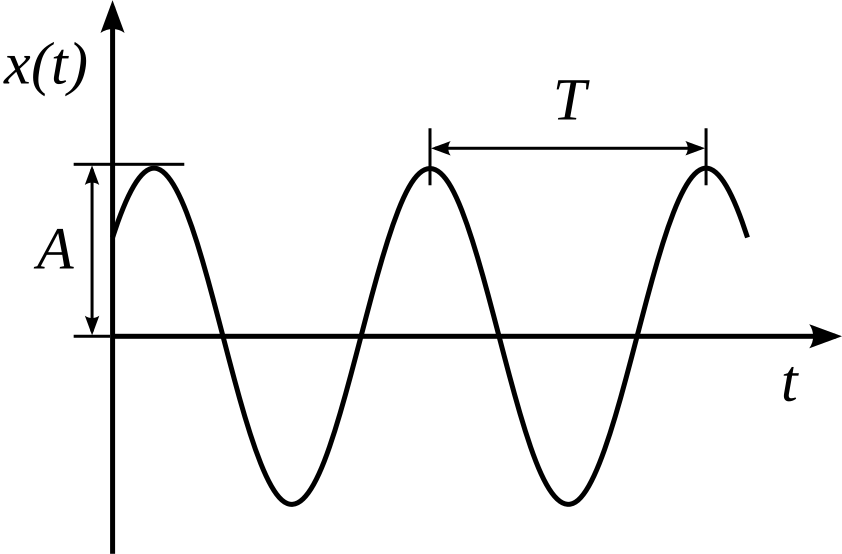

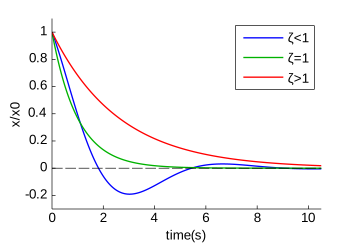

Handbook Chapter 3 and Section IV — scope (not a summary)
Chapter 3 is a full dynamics text (SDOF, MDOF, damping, spectra introduction). Section IV (Ch. 17–21) develops earthquake engineering for buildings and bridges. This page covers basic SDOF and a hand base shear illustration only.
- Chapter 3 — Equations of motion, free and forced vibration, damping models, resonance, introduction to modal analysis and seismic response concepts.
- Chapters 17–21 — Hazard, spectra, ductility, building and bridge seismic design, performance-based methods—see Earthquake Engineering.
What structural dynamics analysis produces
- Natural frequencies and mode shapes (or equivalent period estimates) for comparison with forcing frequencies.
- Time-history or spectral results for seismic or wind design when required by code or client.
- Peak accelerations, displacements, and member forces for fatigue or comfort checks (floors, footbridges).
- Documentation of damping assumptions and modelling choices (mass participation, boundary conditions).
Code and actions (South Africa)
SANS 10160 structures actions for buildings and industrial structures; seismic and other dynamic parts apply when relevant. Combine with material design standards (e.g. concrete, steel) for resistance checks. This page’s SDOF formula is illustrative; seismic design uses site-specific spectra and often multi-modal or time-history analysis.
Notation (common)
- m — mass (kg).
- k — stiffness (N/m) for the SDOF idealisation.
- ωn — natural circular frequency (rad/s).
- fn — natural frequency (Hz); T — period (s).
- ζ (zeta) — damping ratio (fraction of critical damping) in damped models.
Examples in practice
- Floor vibration: walking or rhythmic activity near a natural frequency of the floor bay.
- Earthquake: spectral acceleration vs period; modal combination or time history.
- Wind: along-wind and cross-wind effects on slender structures or masts.
- Machinery: rotating imbalance at a fixed forcing frequency.
Handbook-linked calculators
Three blocks aligned with the usual teaching path (Ch. 3 + seismic overview in Ch. 17–21):
- Natural frequency — undamped SDOF fn and T from k and m.
- Vibration response — steady-state harmonic magnification MF (damped) vs frequency ratio r = f/fn.
- Seismic response — equivalent static base shear V = CsW (you supply Cs from code/spectrum).
Response spectra, modal combination, and performance-based procedures (Ch. 19–21) require software and project-specific hazard data.
Calculator — natural frequency (SDOF)
Handbook — Chapter 3
Undamped single-degree-of-freedom oscillator: enter k in N/m and m in kg. For distributed systems, equivalent k and m must come from a structural model.
Natural frequency
Undamped SDOF natural frequency fn and period T from stiffness k and mass m.
Key terms
- Natural frequency
- Cycles per second (Hz) at which an undamped system oscillates freely.
- Period (T)
- Time for one full oscillation; T = 1/f.
Calculator — vibration response (harmonic magnification)
Handbook — Chapter 3 (forced vibration / resonance)
Frequency ratio r = f / fn (forcing vs natural). Damped steady-state magnification MF = 1 / √[(1−r²)² + (2ζr)²]. Near r = 1 with low ζ, response grows—compare with the message in the output. Use for machinery or harmonic loading; earthquake design uses response spectra (Ch. 17–21), not this alone.
Magnification factor
Steady-state harmonic displacement magnification vs frequency ratio r = f/fn for a given damping ratio ζ.
Calculator — seismic response (equivalent static base shear)
Handbook — Section IV, Chapters 17–21 (conceptual link to lateral-force procedures)
V = Cs W: seismic coefficient × seismic weight (concept used in many codes). Enter Cs from your spectrum or code procedure—this block only multiplies. Full seismic design uses period-dependent spectra, ductility, and combinations per SANS 10160 and project geotechnical input.
Base shear
Equivalent static seismic base shear V = Cs × W from supplied coefficient and seismic weight.
Software and dynamic analysis
Multi-storey frames, bridges, and equipment supports need mass and stiffness models with appropriate boundary conditions and damping. Examples of ecosystems used for dynamic and seismic work (official sites):
- OpenSees — research and practice-oriented nonlinear dynamic analysis.
- SAP2000 / ETABS — modal and time-history workflows.
- STAAD.Pro — dynamic load cases and response spectrum analysis.
- Autodesk Robot Structural Analysis — modal analysis and combinations.
- RFEM — structural analysis; use dynamics features per product documentation.
- Ansys Mechanical — general transient and modal FEA.
No product endorsement—verify that analysis settings, damping, and combination rules match your jurisdiction and peer-review requirements. The SDOF calculator is not a substitute for code-compliant seismic or wind design.
Diagram sources
Educational schematics. Files in Images/structural-dynamics/ were downloaded from Wikimedia Commons into this repo (not copied from other topic folders). Confirm licence on each Commons file page before reuse.