
Geotechnical Engineering — Bearing Capacity
Estimate ultimate and allowable bearing pressure for shallow foundations on soil or rock.
Introduction
Bearing capacity is the pressure the ground can sustain at the foundation level before shear failure or excessive movement. Classical bearing-capacity theory (Terzaghi, Meyerhof, Hansen, Vesic) links footing geometry, embedment, and soil strength to an ultimate value qu; design uses factors of safety or limit-state partial factors to obtain allowable or design bearing resistance.
Strip, square, and circular footings use different shape factors; layered soils, groundwater, and eccentric loads require more detailed analysis than a single formula.


What bearing-capacity analysis produces
- Ultimate bearing pressure qu (or net ultimate) for the chosen failure mechanism and soil model.
- Allowable bearing pressure qa = qu/FS or design value per limit-state format.
- Sensitivity to footing size and embedment for sizing and optimisation.
- Inputs to settlement checks (bearing capacity alone does not control serviceability).
Standards (South Africa)
Structural actions and geotechnical design basis: SANS 10160 (including Part 5 for geotechnical design). Site investigation and testing: SANS 3001 series. Parameters must be consistent with the ground investigation report and groundwater assumptions.
Notation (common)
- qu — ultimate bearing pressure (kPa).
- B — footing width (m); Df — embedment to base.
- c′, φ′ — effective cohesion and friction angle (drained analysis).
- γ — soil unit weight (kN/m³); clarify above/below water table in real design.
- Nc, Nq, Nγ — bearing capacity factors from φ′.
Examples in practice
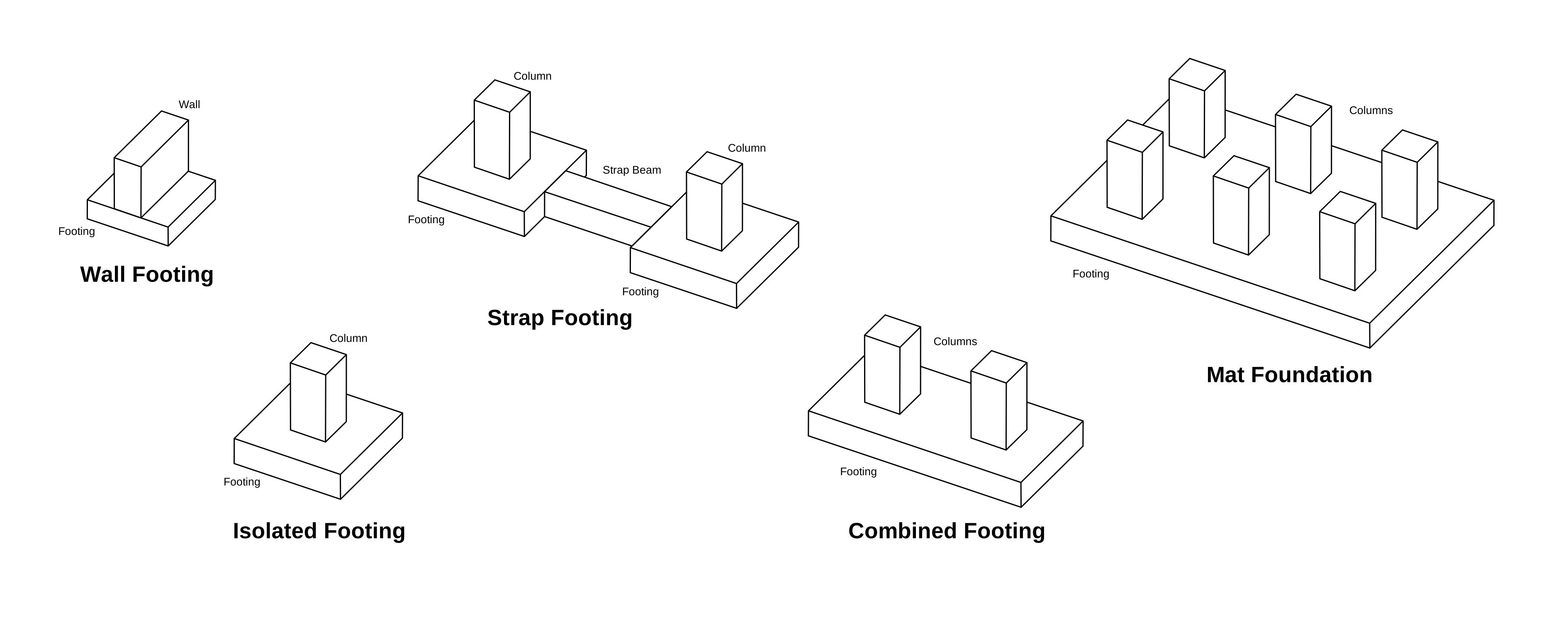
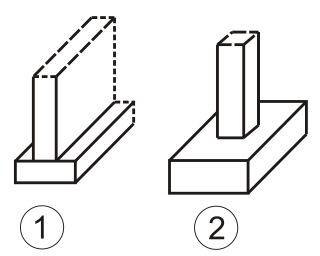
- Pad footing under a column: size B × L from column load and qa.
- Strip footing under a wall: check qu per metre run.
- Raft: simplified bearing check plus differential settlement analysis.
- Weak upper layer over strong stratum: punch-through or layered analysis may govern.
Calculator — strip footing (Terzaghi-style)
Illustrative strip footing with rough base and Terzaghi N-factors (φ′ > 0). For φ′ = 0°, the script uses Nc = 5.14, Nq = 1, Nγ = 0. Overburden q = γ Df when Df > 0. Verify shape factors and water effects for real footings.
Ultimate bearing pressure
Terzaghi ultimate bearing pressure qu for a strip footing from c′, φ′, γ, B, Df.
Key terms
- Ultimate bearing capacity (qu)
- Gross pressure at failure; divide by FS for allowable.
- Bearing capacity factors (Nc, Nq, Nγ)
- Dimensionless factors from soil friction angle.
Software and bearing-capacity workflows
Layered ground, groundwater, eccentric loads, and 3D effects are usually analysed with geotechnical FEA or specialist bearing-capacity tools. Examples (official sites):
- PLAXIS — geotechnical finite-element limit analysis and deformation.
- GeoStudio — slope stability, seepage, and foundation scenarios.
- gINT — logs and parameters feeding design models.
- Rocscience — foundation and slope tools.
- Autodesk Civil 3D — site modelling with geotechnical extensions.
No product endorsement—bearing resistance must align with the approved ground model, groundwater level, and national standard. This calculator is a teaching aid for strip Terzaghi N-factors only.
Diagram sources
Educational schematics. Files in Images/bearing-capacity/ were downloaded from Wikimedia Commons into this repo (not copied from other topic folders). Confirm licence on each Commons file page before reuse.