
Structural Engineering — Earthquake Engineering
Expanded Section IV coverage: damage, buildings, bridges, and performance-based seismic design (Handbook Ch. 18–21)—beyond SDOF and hand base shear.
How this page relates to Chapters 18–21
Section IV of the handbook develops earthquake engineering across several long chapters (including hazard and fundamentals in Ch. 17). Chapters 18–21 are not summarised on this page. What follows is a roadmap of what each chapter is about; project design uses SANS 10160, site-specific hazard, ductility classes, and usually specialist software and peer review.
Illustrations (damage and dynamics)
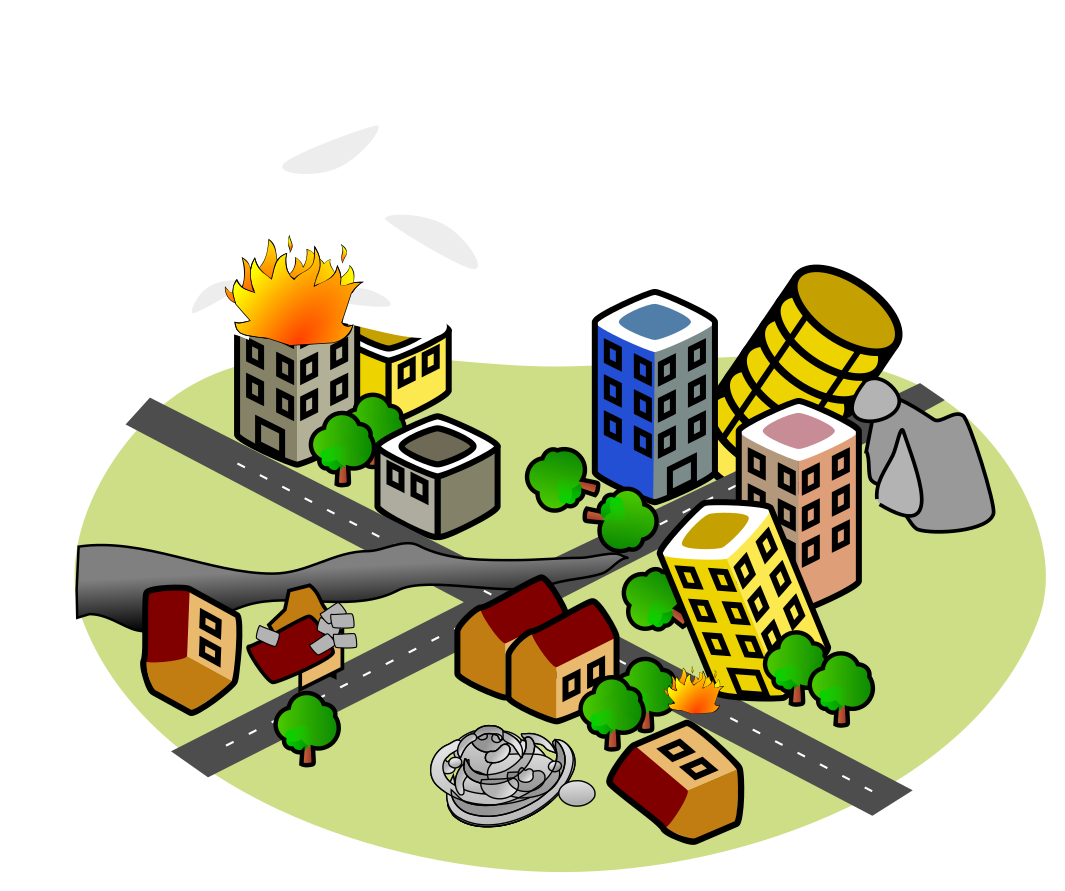
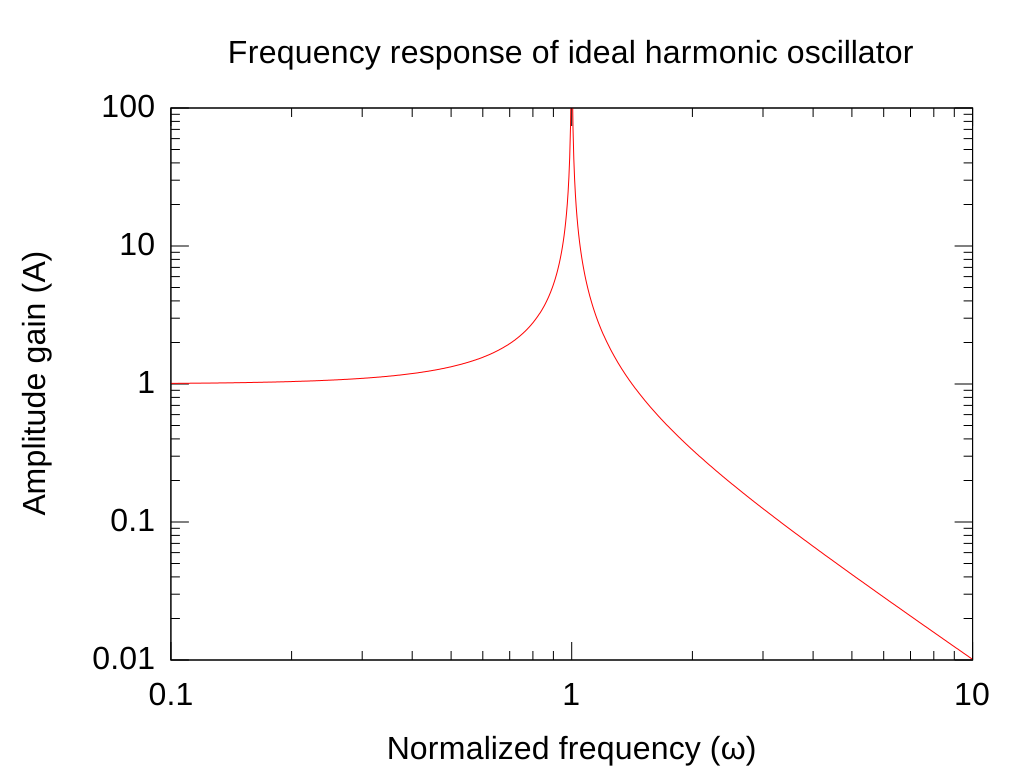
Earthquake engineering ties physical damage and dynamic response to code procedures. The figures below are educational schematics—not project hazard or damage assessments.


What earthquake engineering produces
Beyond Structural Dynamics hand checks, real seismic design delivers:
- Design ground motion — Spectra or equivalent static coefficients per SANS 10160 and site studies.
- System choices — Lateral system type, diaphragm and collector design, capacity design and detailing for ductility.
- Documentation — Analysis reports, peer review packages, and performance-based studies for important or irregular structures.
Code basis (South Africa)
SANS 10160 structures seismic actions and combinations for buildings and similar works. Geotechnical hazard (liquefaction, slope displacement) links to geotechnical standards and site investigation. Always use the current national annex and project-specific hazard where required.
Notation (on-page calculators)
- Base shear — W seismic weight; Cs seismic coefficient; V base shear.
- Period — h building height (m); Ct empirical coefficient per code guidance for the system type.
- Spectral reduction — S spectral acceleration (g); R generic force-reduction placeholder; Sd reduced acceleration.
Basics vs full earthquake engineering
The Structural Dynamics page teaches Chapter 3 mechanics and a minimal seismic hand check (e.g. V = CsW)—useful for intuition and rough period checks. It does not replace the design scope of Ch. 18–21: failure modes in real earthquakes, code-style building and bridge seismic provisions, or performance-based objectives and evaluation.
Chapter 18 — Earthquake damage (handbook scope)
What the chapter covers
- Structural mechanisms — Flexural plastic hinges vs brittle shear; joint shear–flexure balance; wall and frame coupling.
- System failures — Soft/weak storeys, torsion, pounding between blocks, progressive collapse triggers.
- Geotechnical interaction — Liquefaction, lateral spreading, slope movement affecting foundations.
- Non-structural — Cladding, partitions, equipment—life-safety and operational consequences.
- Lessons for design — Why ductility, redundancy, and detailing rules in codes exist; priorities for assessment and retrofit.
Chapter 19 — Seismic design of buildings (handbook scope)
What the chapter covers
- System types — Moment frames, braced frames, shear walls, dual systems; height and regularity effects.
- Analysis procedures — Equivalent lateral force, modal response spectrum, time history; mass and stiffness modelling; accidental eccentricity.
- Design concepts — Capacity design, strong-column/weak-beam ideals, diaphragm forces and collector elements, drift and stability limits.
- Detailing — Ductility classes, confinement, connection design for energy dissipation.
- Integration — Non-structural anchorage, stairs, façades; documentation for authority review.
Chapter 20 — Seismic design of bridges (handbook scope)
What the chapter covers
- Structural forms — Continuous and simply supported spans; deck–pier–foundation load path; bearings and joints.
- Substructure — Pier ductility, shear keys, abutment soil pressure; transverse vs longitudinal response.
- Isolation and dissipation — Base isolation, dampers—when and how they change demand and displacement capacity.
- Soil–structure — Foundation stiffness, liquefaction, kinematic loading on piles.
- Construction — Staged erection, temporary stability, and as-built vs as-designed assumptions.
Chapter 21 — Performance-based seismic design (handbook scope)
What the chapter covers
- Objectives — Explicit hazard levels (frequent, design, maximum considered) and performance targets (IO, LS, CP).
- Analysis — Nonlinear static (pushover) and nonlinear dynamic procedures; fragility and uncertainty.
- Acceptance — Deformation limits, component repairability, residual drift; peer review and regulatory paths.
- When used — Irregular or important structures, retrofit, or when prescriptive code is insufficient.
The on-page V, T, and Sd calculators are teaching toys—Chapter 19–21 design uses approved spectra, multi-modal analysis, and code ductility rules.
Section IV — seismic calculators (illustrative)
Equivalent static base shear, empirical building period, and reduced spectral acceleration for a simple SDOF check—always follow project spectrum and code.
Calculator — base shear V = Cs W
Equivalent static (Ch. 17–19 context)
Equivalent static seismic base shear V = Cs × W from coefficient and seismic weight.
Calculator — empirical building period
Ch. 19 — rough T for regular buildings
Height-based estimate
Approximate fundamental period T ≈ Ct h3/4 from building height (code-style empirical form).
Calculator — design spectral acceleration (SDS-style)
Ch. 17 / 21 — illustrative reduction
Reduced acceleration
Illustrative design spectral acceleration Sd = S/R from spectral acceleration and force-reduction placeholder R.
Software and seismic analysis
Modal and nonlinear seismic analysis, pushover procedures, and code-checked member design require specialist software. Examples (official vendor sites; use current licences and training for production work):
- OpenSees — research-oriented nonlinear analysis.
- SAP2000 — general structural analysis and design.
- ETABS — building lateral-system analysis and design.
- STAAD.Pro — analysis and design workflows.
- Autodesk Robot Structural Analysis — analysis and BIM-linked workflows.
- RFEM — FEA for shells and advanced systems.
- Scia Engineer — integrated modelling and design.
No endorsement of a particular product—seismic design must follow SANS 10160 and the regulator’s expectations for the building class.
Diagram sources
Educational schematics. Diagrams on this page were downloaded from Wikimedia Commons into Images/earthquake-engineering/—not reused from other topic folders.
- City after earthquake.svg — Openclipart-derived city damage schematic.
- Harmonic oscillator gain.svg — Oleg Alexandrov; SDOF gain plot.