
Hydraulics & Hydrology — Hydrology (Rainfall & Runoff)
Link rainfall over a catchment to peak flows and runoff volumes for drainage and flood design.
Introduction
Hydrology quantifies how precipitation becomes streamflow: losses to infiltration and evaporation, temporary storage on land and in channels, and routing to the catchment outlet. For small catchments, the rational method gives a peak discharge from rainfall intensity, area, and a runoff coefficient. Larger or regulated catchments use unit hydrographs, continuous simulation, or regional flood-frequency analysis.
The calculator below implements the common South African form Q = C I A / 360 with I in mm/h and A in hectares.


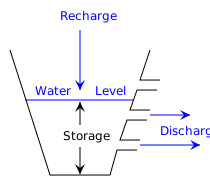

What rainfall–runoff analysis produces
- Design peak discharge for culverts, bridges, and stormwater infrastructure.
- Runoff volume and hydrograph shape for detention basins and flood routing.
- Inputs to 1D/2D hydraulic models (stage, extent, velocity).
- Calibration targets when gauged streamflow or event data exist.
Standards and data (South Africa)
Design rainfall: use SAWS / DWS publications and regional IDF updates as specified by the client. Municipal stormwater and major roads: SANRAL and local by-laws. Align return period, climate change allowances, and loss rates with the approved hydrological memo.
Notation (common)
- C — runoff coefficient (dimensionless; land cover and soil).
- I — rainfall intensity for selected duration and return period (mm/h).
- A — catchment area (ha in the calculator formula).
- Q — peak discharge (m³/s) from the rational form above.
- tc — time of concentration (often used to pick storm duration).
Examples in practice
- Urban subdivision: peak flow to size trunk stormwater pipes.
- Rural bridge: design flood from catchment rational method or regional equation.
- Dam spillway: probable maximum flood or design storm hydrograph per dam safety rules.
- Mine or industrial site: runoff coefficients for paved and rehabilitated areas.
Calculator — rational method
Enter C (0–1 typical), I (mm/h), and A (ha); all must be positive.
Peak discharge
Rational-method peak flow Q = C I A / 360 with I (mm/h), A (ha), Q (m³/s).
Key terms
- Runoff coefficient (C)
- Relates rainfall excess to total rainfall; depends on land use, slope, and soil.
- IDF curves
- Intensity for a given duration and annual exceedance probability.
Software and catchment hydrology
Rainfall–runoff modelling uses design storms, loss models, and routing to the outlet. Examples (official sites):
- HEC-HMS — watershed and hydrologic modelling (USACE).
- EPA SWMM — urban runoff quantity and quality.
- Autodesk Civil 3D — catchments, pipe networks, and hydraulics workflows.
- DHI MIKE — MIKE SHE and related integrated hydrology where applicable.
- HEC-RAS — hydrology links and hydraulic routing for river studies.
No product endorsement—verify rainfall data, subcatchments, and loss parameters against the project brief. The rational-method calculator is a single-value peak check, not a full design hydrograph.
Diagram sources
Educational schematics. Files in Images/hydrology-rainfall-runoff/ were downloaded from Wikimedia Commons into this repo (not copied from other topic folders). Confirm licence on each Commons file page before reuse.