
Construction / Project Engineering — Quantity Takeoff (Measurements)
Turn drawings into measured quantities with clear rules, units, and audit trail.
Introduction
Quantity takeoff is the disciplined extraction of quantities for each work item: earthworks by cut/fill, concrete by element, finishes by area, and services by length or count. Accuracy depends on consistent interpretation of the specification, deductions for openings, and agreed waste and lap rules. Digital takeoff tools speed measurement and markup but still require engineering judgement on what the drawings show.


What takeoffs feed
- Bills of quantities — priced items for tender comparison.
- Procurement — order quantities for materials and fabricated items.
- Planning — productivity and duration when linked to outputs.
- Variation assessment — baseline quantities for change evaluation.
Methods of measurement (South Africa)
Building work often uses ARM (or successor editions) with preambles; civil engineering may use CESMM-style breakdowns. Contracts specify units, what is included or excluded, and how to deal with provisional or prime cost sums. Always cross-check against the employer’s requirements and latest drawing register.
Notation (common)
- BoQ — bill of quantities.
- Gross / net — before vs after deductions (openings, voids).
- Waste — allowance for cutting and spoil per method rules.
- nr — number (count) items.
Examples in practice
- Structural concrete: formwork area vs concrete volume vs reinforcement mass (different items).
- Earthworks: bulk vs compaction and cart-away vs fill from borrow.
- Finishes: wall and floor areas with skirting and deduction rules.
- MEP: cable and pipe runs by route length and fitting counts.
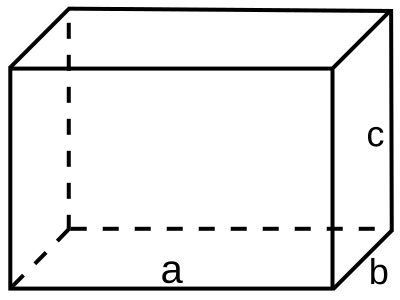
Calculator — volume (rectangular prism)
Enter L, W, and H in metres; output is V = LWH in m³.
Rectangular prism
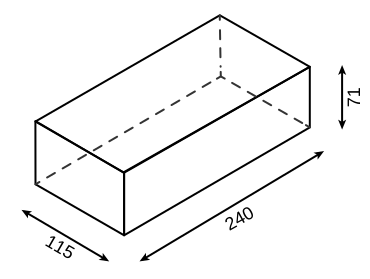
Volume V = L × W × H for a cuboid from edge lengths in metres.
Key terms
- Bill of quantities (BoQ)
- Structured list of work items with quantities and units for pricing.
- Takeoff sheet
- Working record of measurements and calculations supporting BoQ lines.
Software and digital takeoff
2D/3D measurement, collaboration, and export to estimating packages are common on larger projects. Examples (official sites):
- Autodesk Construction Cloud — BIM and construction workflows including quantification in connected models.
- Bluebeam Revu — PDF-based measurement and markup.
- CostX — takeoff and estimating (Exactal).
- PlanSwift — digital takeoff for construction estimating.
No product endorsement—confirm licence coverage, audit trail, and export format with your employer’s systems and procedures.
Diagram sources
Educational figures. Files in Images/quantity-takeoff-measurements/ were downloaded from Wikimedia Commons into this repo (not copied from other topic folders). Confirm licence on each Commons file page before reuse.