
Hydraulics & Hydrology — Stormwater & Drainage Design
Move runoff safely off-site: collection, conveyance, detention, and protection of receiving waters.
Introduction
Stormwater systems limit flooding and erosion by collecting runoff and conveying it to legal outfalls. Open channels and many swales use the Manning equation to relate discharge to cross-section, roughness, and slope. Water-sensitive design adds detention, infiltration, and treatment before discharge to protect rivers and estuaries.
The calculator below gives Q from assumed A, R, n, and S—typical for a channel or a simplified pipe reach; full part-full pipe hydraulics often needs charts or software.
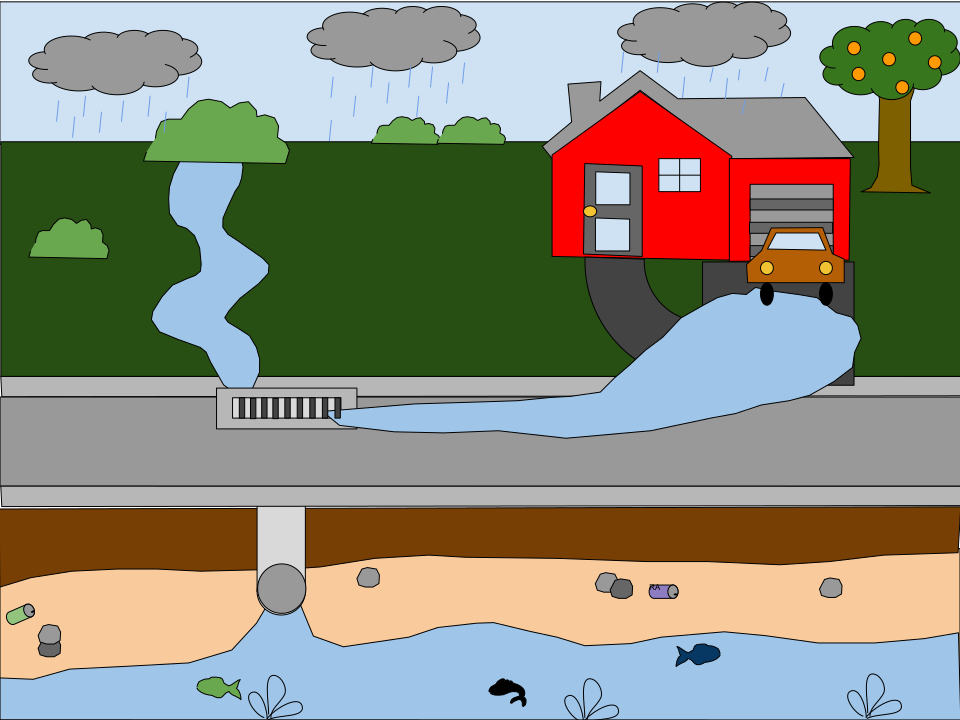

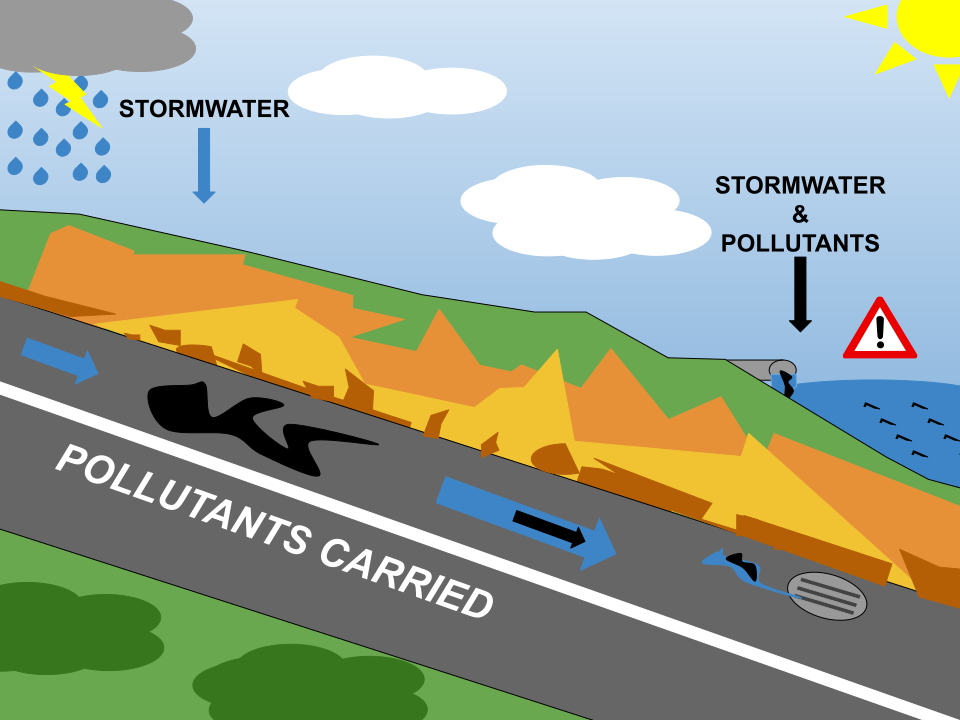

What stormwater design produces
- Pipe and channel sizes for design storms and allowable spread in roads.
- Storage volumes and outlet hydraulics for detention basins and tanks.
- Energy dissipation and erosion control at outfalls and vortex drops.
- Documentation for permits and environmental management plans.
Standards (South Africa)
Follow the municipal stormwater policy and any catchment management framework. Roads: SANRAL drainage requirements where the works are on the national network. Water quality and receiving-water protection: NEMA and DWS guidance as applicable. Coordinate with the geotechnical report for infiltration and pavement drainage.
Notation (common)
- n — Manning roughness (concrete, grass, natural channel tables).
- A — flow area (m²); R — hydraulic radius A/P (m).
- S — friction or bed slope (energy grade for uniform flow).
- Q — discharge (m³/s).
Examples in practice
- Residential estate: trunk stormwater line and on-lot swales to wetland buffer.
- Highway median: grated collection and discharge to lined channel.
- Commercial roof: gutter sizing and downpipe connection to soakaway or network.
- Industrial site: oil–grit separators and spill containment upstream of outfall.
Calculator — Manning discharge
Uniform open-channel or equivalent reach; n, S, R, and A must be positive. Uses Q = (1/n) A R2/3 S1/2.
Discharge
Manning discharge Q = (1/n) A R2/3 S1/2 for a uniform open-channel section.
Key terms
- Design storm
- Rainfall intensity–duration–frequency for the selected return period and duration.
- WQ treatment train
- Sequence of screens, ponds, wetlands, or filters before outfall.
Software and stormwater modelling
Engineers model networks, storage, and sometimes water quality with event or continuous simulation. Examples (official sites):
- EPA SWMM — urban runoff, drainage networks, and storage/treatment units.
- Autodesk Civil 3D — catchments, pipe networks, and grading.
- OpenFlows Storm — StormCAD and related stormwater system modelling (Bentley).
- DHI MIKE — integrated urban and catchment tools where specified.
- Autodesk InfoWorks ICM — integrated catchment and drainage network modelling.
No product endorsement—match software capabilities to the project's hydrology memo, WQ targets, and approval process. The Manning calculator is a single-section capacity check.
Diagram sources
Educational schematics. Files in Images/stormwater-drainage-design/ were downloaded from Wikimedia Commons into this repo (not copied from other topic folders). Confirm licence on each Commons file page before reuse.