
Hydraulics & Hydrology — Groundwater (Basic Level)
Water in soil and rock: heads, aquifers, and steady seepage described by Darcy's law.
Introduction
Groundwater occupies voids below the water table (unconfined) or under pressure in confined aquifers. Engineers use hydraulic head maps and Darcy's law (v = k i) when flow is laminar through the porous matrix. Pumping tests and numerical models extend this to transient drawdown and well interference.
The calculator below applies v = k i with your chosen gradient and permeability.
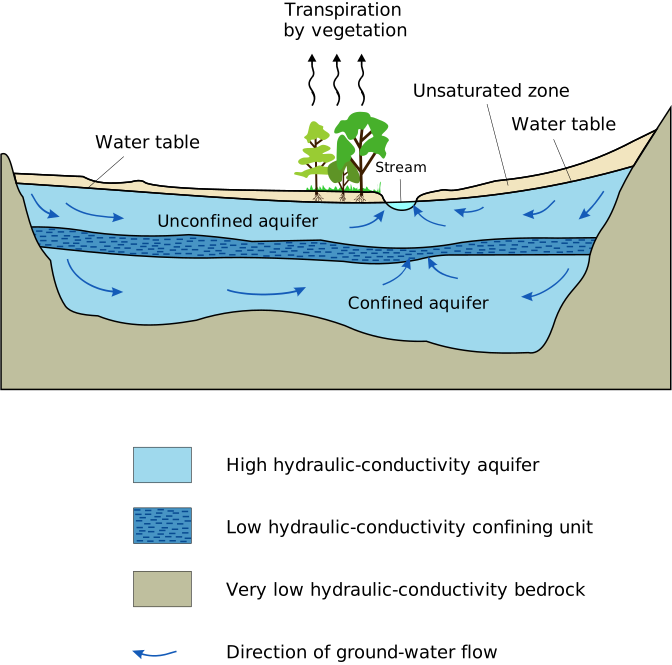

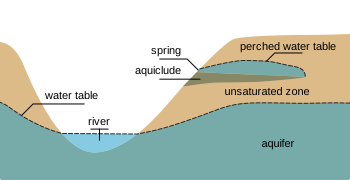

What basic groundwater concepts support
- Scoping dewatering and seepage into excavations.
- Order-of-magnitude flow for containment and remediation concepts.
- Communication with hydrogeologists on heads, aquifers, and monitoring.
- Input to geotechnical effective-stress and slope analyses.
Standards and regulation (South Africa)
Testing and reporting: SANS 3001 geotechnical series as cited in the project. Groundwater licensing and resource protection: DWS requirements. Environmental authorisations: NEMA and relevant listed activities. Always align with the groundwater specialist report for the site.
Notation (common)
- k — hydraulic conductivity (permeability), often m/s.
- i — hydraulic gradient (−dh/ds along flow).
- v — Darcy (discharge) velocity (not average pore velocity unless divided by porosity).
- h — total hydraulic head; z — elevation head.
Examples in practice
- Excavation beside a river: estimate inward seepage for sump sizing.
- Landfill liner: check gradient-driven leakage order of magnitude.
- Water supply borehole: conceptual unconfined vs confined response.
- Irrigation: saltwater intrusion risk in coastal aquifers (advanced studies).
Calculator — Darcy velocity
Enter k (m/s) and i (positive); output is v = k i (m/s).
v = k i
Darcy seepage velocity v = k i from hydraulic conductivity and hydraulic gradient.
Key terms
- Aquifer
- Formation that stores and transmits significant water.
- Piezometric head
- Elevation of water level in a piezometer (confined aquifer).
Software and groundwater modelling
Regional and site-scale studies use finite-difference or finite-element groundwater models. Examples (official sites):
- USGS MODFLOW — reference groundwater flow modelling.
- Aquaveo GMS — graphical MODFLOW interface and workflows.
- DHI FEFLOW — finite-element groundwater and heat/mass transport.
- DHI MIKE — integrated surface–groundwater tools where applicable.
- gINT — borehole and test data for parameter selection.
No product endorsement—boundary conditions, layers, and calibration must match investigation data. The Darcy calculator is a 1D steady check only.
Diagram sources
Educational schematics. Files in Images/groundwater-basic-level/ were downloaded from Wikimedia Commons into this repo (not copied from other topic folders). Confirm licence on each Commons file page before reuse.