
Geotechnical Engineering — Settlement Analysis
Predict immediate, consolidation, and creep settlement of foundations under load.
Introduction
Settlement is vertical movement of the ground surface (or structure) under load. Immediate settlement occurs under undrained loading in clays and elastic deformation in sands. Primary consolidation in saturated clays is the slow squeezing of pore water; secondary compression (creep) may follow. Differential settlement between footings causes distortion and damage—often more critical than total settlement.
Elastic solutions (half-space, layered elasticity) give one component; oedometer and field tests calibrate compressibility for clays.
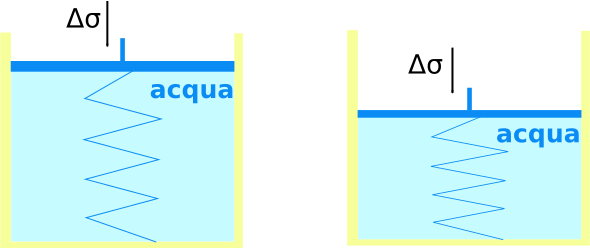



What settlement analysis produces
- Total settlement at critical points (centre/corner of raft, single footing).
- Differential settlement and tilt between supports for structural and architectural limits.
- Time–settlement curves for consolidation (when rate of settlement matters).
- Documentation of assumptions (E, ν, layer thickness, drainage) for peer review.
Standards (South Africa)
Geotechnical design basis and serviceability: SANS 10160-5. Soil testing for modulus and consolidation: SANS 3001 series (oedometer, triaxial, etc.). Compare predictions with observed performance where monitoring is specified.
Notation (common)
- s — settlement (often mm in reporting).
- E, ν — Young’s modulus and Poisson’s ratio (elastic estimates).
- Cc, cv — compression index and coefficient of consolidation (clays).
- Δσ′ — increment of effective vertical stress from foundation load.
Examples in practice
- Pad footing on dense sand: mostly immediate settlement; check adjacent footings for differential.
- Wide raft on soft clay: consolidation governs total settlement over months or years.
- Embankment on compressible subsoil: staged construction or vertical drains to control rate.
- Machine foundations: dynamic settlement and resonance checked separately.
Calculator — elastic settlement (order of magnitude)
Highly simplified elastic estimate for a flexible footing approximation: q and E in kPa, B in m. The script uses a fixed shape factor (0.8) as an order-of-magnitude guide—replace with Boussinesq influence factors or FE for real projects.
Approximate settlement
Order-of-magnitude elastic settlement s from contact pressure q, footing width B, E, and ν.
Key terms
- Consolidation
- Time-dependent volume change in saturated clays as pore water drains.
- Modulus (E)
- Stiffness of soil; use correlated values from in-situ or lab tests.
Software and settlement analysis
Layered soils, groundwater, and construction staging are usually modelled with geotechnical FEA or 1D/2D consolidation tools. Examples (official sites):
- PLAXIS — deformation and consolidation in 2D/3D.
- GeoStudio — consolidation, settlement, and slope interaction.
- gINT — borehole data feeding parameter selection.
- Autodesk Civil 3D — site surfaces and volumes with geotechnical modules.
- Rocscience — Settle3 and related foundation tools.
No product endorsement—verify moduli and drainage boundaries against investigation data. This elastic shortcut does not replace consolidation analysis for soft clays.
Diagram sources
Educational schematics. Files in Images/settlement-analysis/ were downloaded from Wikimedia Commons into this repo (not copied from other topic folders). Confirm licence on each Commons file page before reuse.