
Transportation Engineering — Pavement Engineering
Layers, materials, and traffic loading so the road carries repeated wheel loads over its design life.
Introduction
Pavement engineering sizes and selects surfacing, bases, subbases, and subgrade improvement so that rutting, cracking, and roughness stay within limits. Traffic is often summarised as equivalent standard axle loads (ESALs) using a fourth-power damage law for flexible pavements. Rigid slabs spread loads differently; joint design, steel, and foundation support control performance. Climate, moisture, and construction quality strongly affect long-term behaviour.


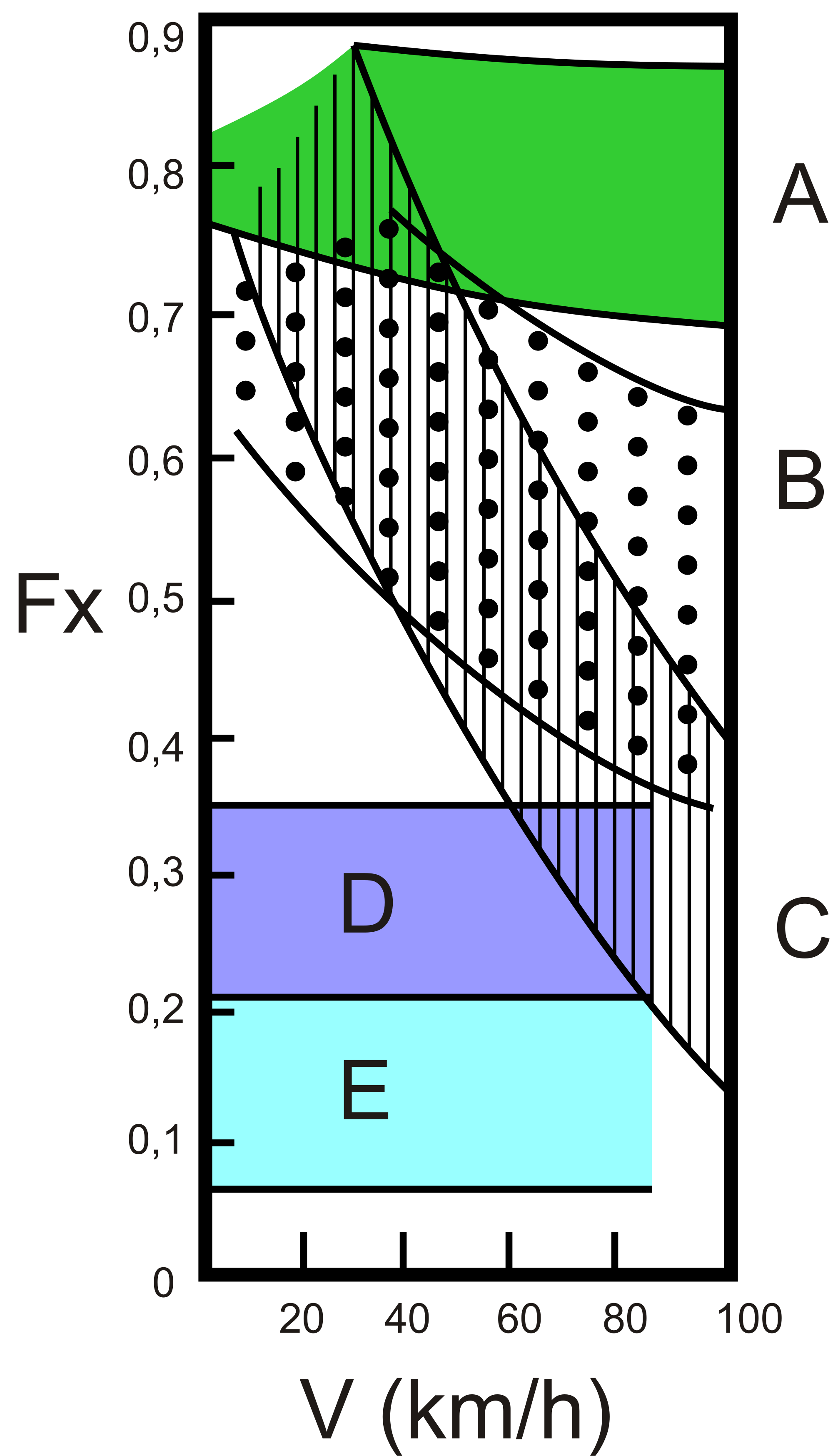
.svg)
What pavement design delivers
- Structural capacity — thickness and stiffness of bound and unbound layers for predicted traffic.
- Surfacing — skid resistance, texture, and durability for climate and traffic.
- Drainage — crossfall, permeability, and layers that limit moisture in the subgrade.
- Maintenance strategy — timing of overlays, mill-and-fill, or rehabilitation.
Standards and guidance (South Africa)
Project specifications typically reference COLTO standard specifications for asphalt and granular materials, SANRAL methods on national routes, and test methods from SANS for binders and aggregates. Align layer types, compaction, and design traffic with the employer’s works information—this page does not replace a pavement number register or catalogue design.
Notation (common)
- P — axle or group load (kN).
- Pref — reference single-axle load (often 80 kN).
- N — repetitions at that load level.
- ESAL — damage-equivalent count of standard axles (definition varies by agency).
Examples in practice
- Heavy freight route: thick asphalt structure or concrete alternative with drainage and subgrade stabilisation.
- Urban bus lane: rutting resistance and interface with manholes and utilities.
- Overlay design: milling depth, levelling, and bond between new and existing layers.
- Airfield: different load spectra and compaction standards—still mechanistic or catalogue-based.
Calculator — ESAL (fourth-power law)
Enter axle load P, reference Pref, and repetitions N. Output is N (P/Pref)4—one simplified ESAL contribution; sum many levels in real design.
Equivalent single-axle loads
Damage-equivalent ESAL count N(P/Pref)4 for one load level (fourth-power law illustration).
Key terms
- ESAL
- Damage-equivalent number of reference single-axle loads (here, illustrative fourth-power model).
- Load spectra
- Distribution of axle loads and groups over the design life—converted to ESALs or used in mechanistic design.
Software and pavement design
Thickness design, material catalogues, and calibration to climate use agency or commercial tools. Examples (official sites):
- Autodesk Civil 3D — corridors, sections, and quantities for road structures.
- OpenRoads Designer — road and pavement modelling (Bentley).
- AASHTOWare Pavement ME Design — mechanistic-empirical pavement analysis (where licensed).
- FHWA — National Concrete Pavement Technology Center — technical resources on concrete pavement (US context).
No product endorsement—verify inputs against your contract specifications, material tests, and independent pavement engineering review.
Diagram sources
Educational figures. Files in Images/pavement-engineering/ were downloaded from Wikimedia Commons into this repo (not copied from other topic folders). Confirm licence on each Commons file page before reuse.