
Structural Engineering — Advanced Design Theory
Reliability-based design: probability, safety factors, and risk analysis—why limit-state codes look the way they do.
How this page relates to Chapter 12
Chapter 12 — Reliability-based structural design is a full development of limit-state philosophy: random variables for actions and resistances, calibration of partial factors, system effects, and links to code formats. This page is not a substitute for the chapter. The sections below organise the same ideas as a study map; the three calculators are tiny illustrations (Gaussian β, partial-factor combination, EMV screening).
Introduction
Structural codes express acceptable safety through calibrated partial factors and load combinations. Behind that lies a probabilistic view: variable loads, uncertain material strength, and model error. Chapter 12 shows how reliability targets (e.g. annual failure probability or reliability index β) are translated into the γ and φ factors you see in national standards.
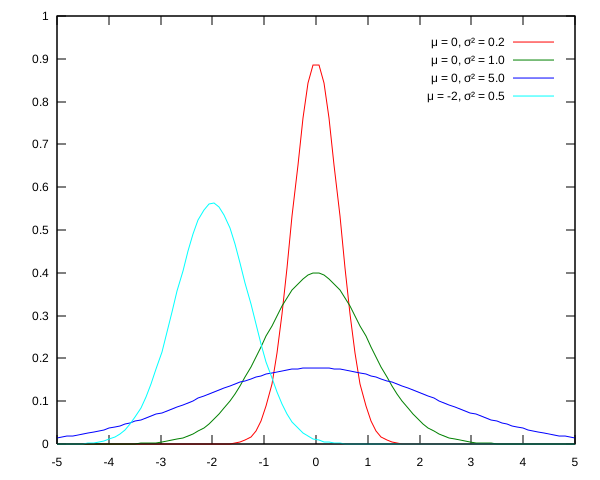

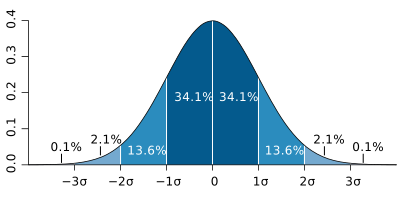

What advanced design theory produces
Typical outputs and decisions when reliability and risk frame the conversation (not member schedules):
- Target reliability or failure probability consistent with consequence class and code calibration assumptions.
- Partial factors and combination rules justified or checked against probabilistic models of actions and resistances.
- Risk registers or screening metrics (e.g. EMV, FN curves) for major projects or performance-based options.
- Documentation that assumptions on distributions and correlation are explicit—inputs to peer review or authority submission.
Code basis (South Africa)
SANS 10160 structures actions and load combinations for buildings and industrial structures; partial factors and combination expressions are the operational form of reliability targets for those limit states. Material design standards (steel, concrete, etc.) supply resistance models and γM / φ-style factors. This page’s calculators are illustrative—always use the code edition and national annexes named in the project brief.
Notation (illustrative)
- β — Reliability index (FORM/SORM context in Chapter 12); the on-page formula is a Gaussian shortcut.
- γG, γQ — Partial factors on permanent and variable characteristic actions.
- φ, γM — Resistance and material factors in design inequality Ed ≤ Rd.
- Pf — Failure probability; EMV — expected monetary value for risk screening.
Chapter 12 — Probability and reliability (handbook themes)
What the chapter develops
- Random variables — Models for action effects and resistance (distributions, coefficients of variation, correlation between variables).
- Limit-state functions — G = R − S (or generalised forms); failure when G ≤ 0.
- Reliability index β — First-order and second-order reliability methods (FORM/SORM); mapping β to failure probability for calibration.
- Code calibration — How chosen target reliabilities lead to partial factors and combination rules in limit-state codes.
The β calculator uses a closed-form Gaussian R–S model—pedagogic only; full Chapter 12 uses lognormal variables, correlated loads, and multi-degree systems.
Chapter 12 — Partial factors and combinations (handbook themes)
From reliability targets to checkable inequalities
- γG, γQ — Partial factors on permanent and variable actions; combination rules (leading variable, accompanying factors).
- γM, φ — Material and resistance factors tying mean or characteristic strengths to design resistance.
- Design inequality — Ed ≤ Rd (or regional equivalents); annexes in SANS and project briefs fix numerical values.
The γG/γQ combination calculator is a one-line illustration—not a load-combination engine from Chapter 12 or SANS 10160.
Chapter 12 — Risk and consequences (handbook themes)
Beyond element reliability
- Consequence classes — Human life, economic loss, environmental harm; how they influence target β or factor choices.
- System reliability — Redundancy, alternative load paths, progressive collapse considerations.
- Decision tools — Cost–benefit and expected loss for screening; performance-based design when prescriptive rules are insufficient.
The EMV block (P × C) is a coarse screening tool, not a full risk register or societal risk analysis from the chapter.
Chapter 12 — calculators (illustrative)
Gaussian R and S independence model for β; combined action for limit-state checking; simple EMV for risk screening.
Calculator — reliability index β (R − S, normal)
First-order reliability
Reliability index β for independent normal resistance R and action effect S (closed-form Gaussian illustration).
Calculator — combined action (partial factors)
Characteristic to design (illustrative)
Design value of combined permanent and variable actions Fd = γGG + γQQ.
Calculator — expected loss (risk screening)
Probability × consequence
Expected monetary value EMV = P × C for simple risk screening.
Software and reliability tools
Calibration of factors, Monte Carlo simulation, FORM/SORM, and system reliability usually require numerical tools beyond the hand checks on this page. Examples (official sites; use current licences and training for production work):
- UQLab — uncertainty quantification and reliability (MATLAB).
- COSSAN — computational stochastic mechanics and reliability.
- OpenSees — when limit-state functions require nonlinear structural FE.
- SAP2000 / ETABS — analysis platforms that pair with external UQ workflows.
- R — statistical computing for custom Monte Carlo and distribution fitting.
- Python — with SciPy / NumPy for probabilistic models (engineer’s own verification required).
No endorsement of a particular toolchain—match tools to your office QA, code implementation, and peer-review requirements. Hand formulas here support understanding, not certified reliability assessments.
Diagram sources
Educational diagrams. Files in Images/advanced-design-theory/ were downloaded from Wikimedia Commons into this repo (not copied from other topic folders). Verify licence on each file page before reuse.