
Hydraulics & Hydrology — Open Channel Flow
Free-surface flow: depth, velocity, and energy change with discharge, slope, and channel shape.
Introduction
Open-channel flow has a free surface at atmospheric pressure. For gradually varied flow, engineers use energy and momentum concepts; for uniform flow in a long prismatic reach, the Manning or Chézy equation relates mean velocity to hydraulic radius, slope, and roughness. Supercritical and subcritical regimes (Froude number) control whether disturbances move upstream and where hydraulic jumps form.
The calculator below assumes fully rough turbulent flow and uniform conditions; it does not replace water-surface profile computation for controls, bends, or bridges.
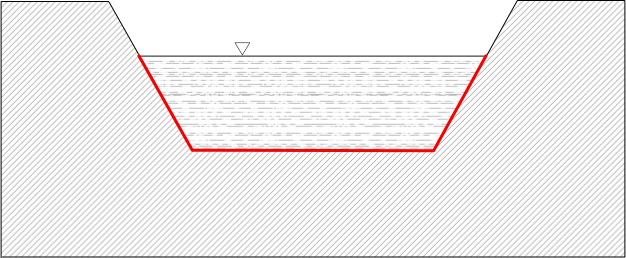

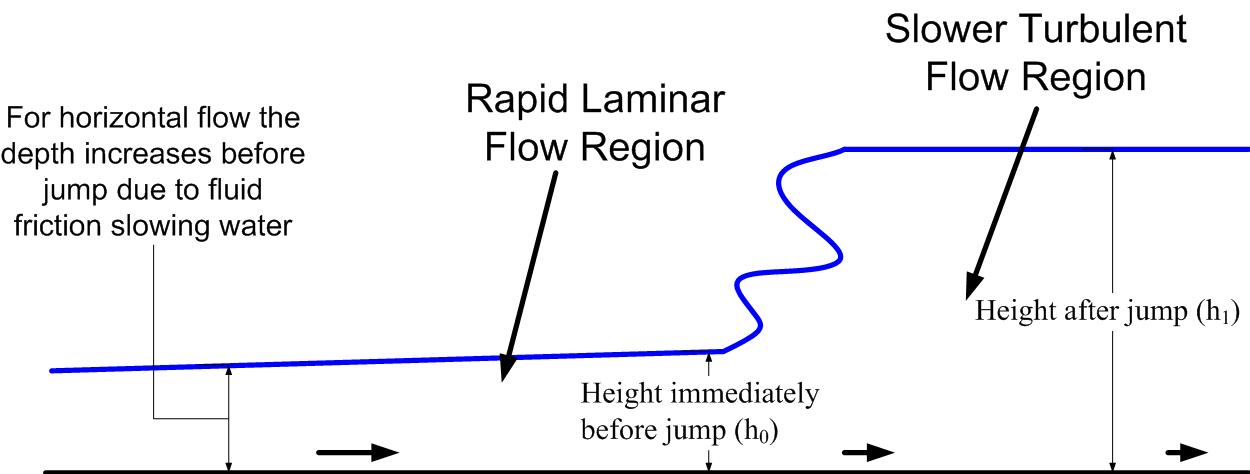

What open-channel analysis produces
- Stage–discharge rating and capacity for channels, culverts, and spillways.
- Water-surface profiles and backwater from bridges, gates, and constrictions.
- Energy loss and jump location for transitions and stilling basins.
- Flood levels and freeboard checks against embankments and structures.
Standards and manuals (South Africa)
Road and stormwater drainage: follow SANRAL and municipal by-laws where applicable. Dam spillways and reservoirs: DWS and project dam-safety rules. Always match the design storm, return period, and roughness to the approved hydrological report.
Notation (common)
- n — Manning roughness coefficient (tables; verify for vegetation and debris).
- R — hydraulic radius A/P (m).
- S — bed slope (energy slope for uniform flow).
- V, Q — mean velocity and discharge.
- Fr — Froude number V/√(gDh) with hydraulic depth Dh = A/B (wide channel often Dh ≈ y).
Examples in practice
- Stormwater channel: capacity check for a given design storm peak flow.
- River crossing: backwater at bridge piers; scour protection.
- Spillway chute: supercritical flow and stilling basin with hydraulic jump.
- Irrigation canal: uniform-flow depth for lined and earthen sections.
Calculator — Manning (SI)
Uniform flow; n, R (m), and S (slope as decimal fraction) must be positive. Output is mean velocity V; multiply by area for Q if needed.
Mean velocity
Uniform-flow mean velocity V from Manning: V = (1/n) R2/3 S1/2 (SI).
Key terms
- Hydraulic radius (R)
- Flow area divided by wetted perimeter.
- Manning's n
- Empirical roughness coefficient (larger n = rougher boundary).
Software and open-channel hydraulics
Engineers use 1D and 2D hydraulic models for profiles, structures, and flood mapping. Examples (official sites):
- HEC-RAS — steady and unsteady 1D/2D river and floodway analysis (USACE).
- EPA SWMM — urban drainage and channel/pipe networks.
- Autodesk Civil 3D — civil design with hydraulics and corridor tools.
- DHI MIKE — MIKE+ and related hydrodynamic modelling.
- TUFLOW — 1D/2D/3D flood and urban hydraulics.
No product endorsement—select tools to match your project's QA, meshing, and regulatory deliverables. The Manning calculator is a uniform-flow spot check only.
Diagram sources
Educational schematics. Files in Images/open-channel-flow/ were downloaded from Wikimedia Commons into this repo (not copied from other topic folders). Confirm licence on each Commons file page before reuse.