
Structural Engineering — High-Performance Materials
Modern materials, advanced engineering—high-performance steel, high-performance concrete, and FRP composites (Handbook Ch. 14–16).
How this page relates to Chapters 14–16
Each handbook chapter covers material science, design philosophy, and code-style treatment for that class of material. This page does not summarise Chapters 14–16. Below is a topic map per chapter; the three calculators are single teaching checks (plastic modulus for HP steel, cube–cylinder correlation, FRP strip nominal force).
Introduction
Higher strength and tailored microstructures change governing limit states: stability, bond, creep, fatigue, and fire may dominate instead of gross yielding. Production depends on batch testing, qualified procedures, and collaboration with mills, precast plants, or composite installers—not on generic formulas alone.
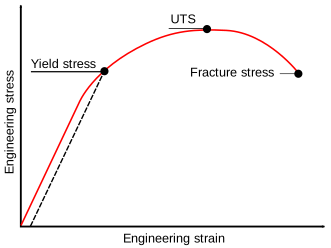
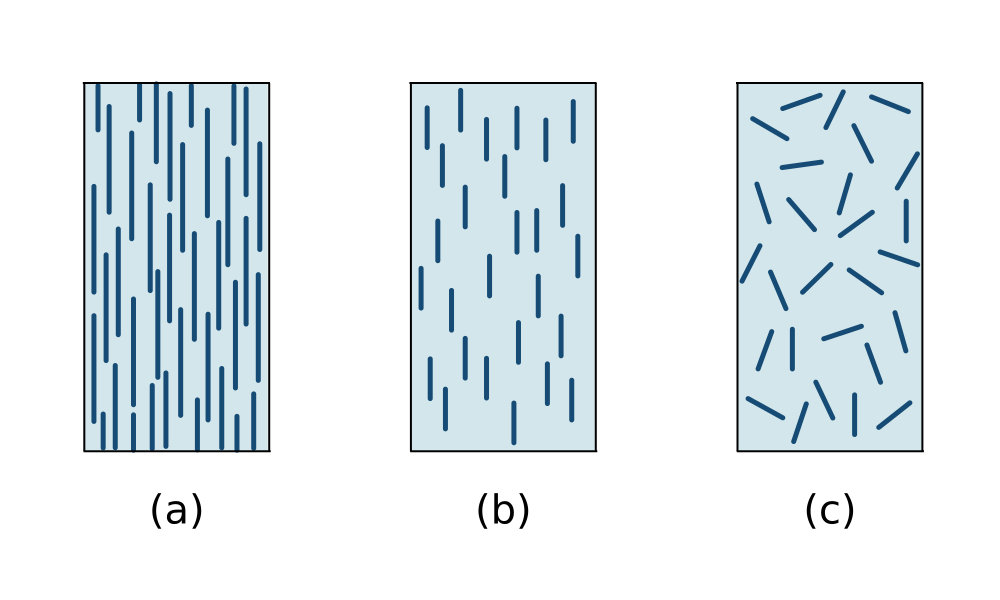
The diagrams below tie the three strands together: a ductile stress–strain idealisation (steel), a cement-stone schematic (high-strength concrete chemistry), and fiber-reinforced composite typologies (FRP systems).




What high-performance materials design produces
Beyond elastic analysis from Structural Analysis, these systems need material-specific outputs and documentation:
- HP steel — Mill certificates, through-thickness properties, weld procedure specs, and section properties for high fy; limit states often include plate stability and fatigue-sensitive details.
- HPC — Mix designs with SCMs and admixtures, strength–age curves, creep and shrinkage parameters, and durability indicators tied to exposure class.
- FRP — Product data sheets, environmental reduction factors, anchorage layouts, and often proprietary design manuals for externally bonded strengthening.
Code basis (South Africa)
SANS 10162 (steel structures) governs structural steel including high grades when the National Regulator accepts the material for the project. SANS 0100 (concrete) sets material factors and durability for structural concrete, including high-strength mixes when designed and executed under the same framework. FRP strengthening is often implemented via approved systems and specialist literature—align environmental factors and reduction coefficients with the basis assumed in your calculation package.
Use the handbook chapters as conceptual maps; the signed standard and project specification always win on site.
Notation (common symbols)
- Steel (flexure) — M factored moment; fy yield strength; φ resistance factor; Zx,req required plastic modulus about the major axis.
- Concrete — fcube, fcyl compressive strengths from cube/cylinder tests (not the same number—correlations are indicative).
- FRP strip — ffu ultimate tensile strength of FRP; Af area of strip; CE environmental factor; ψ strength reduction; Pn nominal axial capacity of the strip.
Chapter 14 — High-performance steel (handbook scope)
Themes the chapter addresses
- Grades and supply — Very high fy, toughness, weldability; through-thickness ductility and lamellar tearing in thick plates.
- Limit states — Local and global buckling at high stress levels; fatigue-sensitive details; fracture mechanics where relevant.
- Fabrication — Heat input, preheat, consumables, PWHT, and inspection classes tied to grade and joint type.
- Coordination — Matching certificates to connection design and to seismic or bridge specifications when applicable.
The Z calculator only sizes plastic modulus from M and fy—Chapter 14 design still requires full member, connection, and fabrication checks per SANS 10162 and project specs.
Chapter 15 — High-performance concrete (handbook scope)
Themes the chapter addresses
- Mix design — Low w/b, SCMs, rheology; heat of hydration and early-age cracking in massive members.
- Mechanical behaviour — Higher fc′, stiffer stress–strain response, bond to bars and strands; creep and shrinkage models.
- Durability — Chloride ingress, carbonation, cover and permeability as performance targets.
- Structural use — Columns, high-strength floors, hybrid steel–concrete systems; coordination with Ch. 7 ordinary RC and Ch. 8 prestress.
The cube→cylinder calculator is a rough lab correlation—Chapter 15 and SANS 0100 require project-specific test data and material factors.
Chapter 16 — Fiber-reinforced polymers (FRP) (handbook scope)
Themes the chapter addresses
- Materials — Glass, carbon, aramid; matrices; environmental and creep effects.
- Strengthening — Externally bonded strips/sheets; anchorage length, debonding, and shear transfer to concrete or steel.
- Design — Orientation, environmental reduction CE, strength reduction ψ; fire and durability limits.
- Hybrid systems — FRP with conventional reinforcement; testing and often proprietary design manuals.
The FRP strip calculator gives a nominal axial capacity line—Chapter 16 and product approvals govern debonding, wrapping schemes, and fire protection.
Chapters 14–16 — calculators (illustrative)
Required plastic modulus for HP steel; approximate cylinder strength from cube; nominal FRP strip capacity with environmental reduction.
Calculator — HP steel required Z (flexure)
Zx,req from M and fy
Required plastic section modulus for major-axis flexure from design moment, yield strength, and φ.
Calculator — concrete cube → cylinder (approximate)
Chapter 15 — lab strength correlation
Illustrative conversion
Approximate cylinder strength from cube strength (fcyl ≈ 0.80 fcube).
Calculator — FRP strip nominal capacity
Chapter 16 — environmental reduction
Illustrative axial strip
Nominal axial capacity of an FRP strip from ultimate strength, area, environmental factor CE, and ψ.
Software and high-performance materials
Nonlinear stability, composite action, FRP bond–slip, and code-checked member design usually require specialist software and supplier tools—beyond the hand checks on this page. Examples (official vendor sites; use current licences and training for production work):
- OpenSees — research-oriented nonlinear analysis (fiber sections, materials).
- SAP2000 — general structural analysis and design.
- ETABS — building systems and lateral analysis.
- STAAD.Pro — analysis and design workflows.
- Autodesk Robot Structural Analysis — analysis and BIM-linked workflows.
- RFEM — FEA including shells and advanced materials.
- Scia Engineer — integrated modelling and design.
No endorsement of a particular product—choose per project, code, and office practice. Match material models to SANS and to mill or FRP supplier data.
Diagram sources
Educational schematics. Diagrams on this page were downloaded from Wikimedia Commons into Images/high-performance-materials/—not reused from other topic folders. Verify licence on each Commons file page before reuse.
- Stress-strain curve.svg — Sigmund; ductile stress–strain with offset yield.
- Simplified model of the cement stone structure.svg — DR00GINNIK; cement paste microstructure schematic.
- Fiber-reinforced composites tipology.svg — Daniele Pugliesi; composite fiber layouts.