
Construction / Project Engineering — Resource Management
Match people, plant, and materials to the work—and track whether productivity stacks up.
Introduction
Resource management allocates limited inputs to activities: labour skills and numbers, owned or hired plant, and materials with lead times and laydown space. Levelling smooths peaks; utilisation measures how much of available time is productive. Shortages delay the critical path; excess capacity wastes cost. Good systems link BoQ quantities, schedule windows, and site logistics.
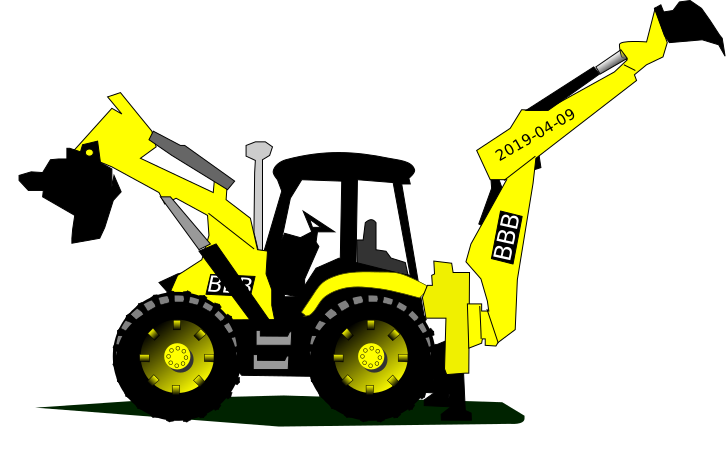



What resource management delivers
- Manpower and plant histograms — peaks vs limits (gates, crane time).
- Material call-offs — aligned to installation sequence and cash flow.
- Productivity feedback — planned vs earned quantity per time period.
- Conflict resolution — trade stacking and shared access.
Standards and site context (South Africa)
Comply with occupational health and safety requirements for plant certification, lifting, and personnel. Align employment and subcontract terms with project rules. For public-sector work, add local content or skills targets when specified in the tender. Environmental controls may restrict noise, dust, and hours.
Notation (common)
- p — output rate per hour (same unit as programme quantity).
- h — hours booked to the activity.
- LOP — loss of productivity (claims and forensic planning).
- Mobilisation — cost and time to bring plant or crews to site.
Examples in practice
- Concrete pour: pump, vibrators, and finishing crew sized to slab zones per shift.
- Earthworks: truck cycle productivity vs target m³/day.
- Steel erection: crane hook time shared across trades.
- Finishes: gang size limited by workface availability.
Calculator — output
Enter output per hour and hours. Result is Q = p × h in consistent units.
Productivity
Output Q = (output per hour) × hours on task for a crew or plant.
Key terms
- Productivity
- Output per unit time or resource—compare planned vs actual for variance.
- Utilisation
- Share of available time that is productive (crew or plant).
Software and resource planning
Scheduling, workforce, and field tools often integrate. Examples (official sites):
- Procore — construction management with resource and field tracking.
- CCS — Candy project control (programme and cost in Southern Africa).
- Assignar — workforce and equipment allocation for construction.
- Autodesk Construction Cloud — coordination, quantities, and site workflows.
No product endorsement—choose tools that match your contract reporting, payroll integration, and data residency requirements.
Diagram sources
Educational figures. Files in Images/resource-management/ were downloaded from Wikimedia Commons into this repo (not copied from other topic folders). Confirm licence on each Commons file page before reuse.