
Geotechnical Engineering — Slope Stability
Evaluate factor of safety against sliding along potential slip surfaces in natural slopes and embankments.
Introduction
Slope failure occurs when shear stress along a potential slip surface exceeds available strength (effective stress analysis). Engineers use limit equilibrium (Fellenius, Bishop, Janbu, Spencer) or finite-element strength reduction for complex geometry and layering.
The infinite slope model is a closed-form check for long slopes with parallel seepage; real cuts and embankments usually need searched critical surfaces.
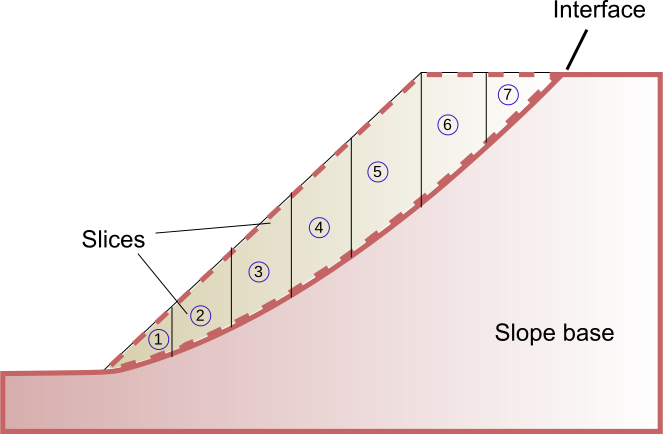

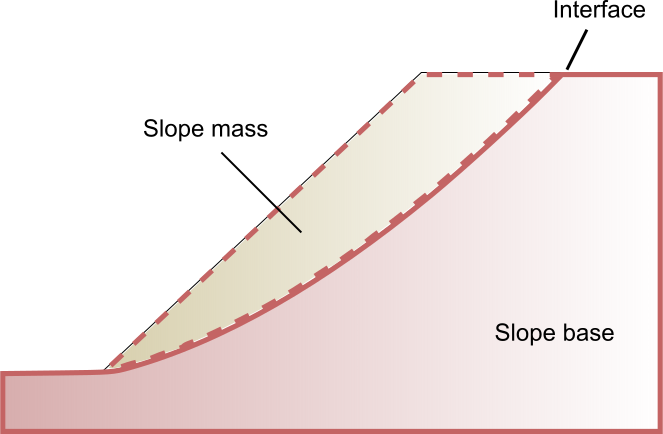

What slope-stability analysis produces
- Factor of safety for assumed or searched failure mechanisms.
- Critical slip surface geometry (circle, non-circular, wedge) when using search methods.
- Sensitivity to groundwater, material strength, and surcharge or seismic coefficients.
- Support for stabilisation options (benching, drains, nails, anchors).
Standards (South Africa)
Geotechnical design basis: SANS 10160-5. Soil strength testing: SANS 3001. Road cuttings and embankments may follow national road authority guidance. Always tie parameters to the ground model and monitoring where required.
Notation (common)
- F — factor of safety (shear strength / mobilised stress).
- β — slope angle; H — depth of sliding mass normal to slope (model-dependent).
- c, φ — cohesion and friction angle (effective stress parameters when using c′, φ′).
- ru — pore-pressure ratio in advanced analyses.
Examples in practice
- Road cut in residual soil: circular slip search with design groundwater.
- Tailings dam embankment: staged construction and undrained/drained stages.
- Natural hillside: debris-flow and deep-seated mechanisms may control design.
- Reinforced slope: include nail or geogrid forces in limit equilibrium.
Calculator — infinite slope (dry)
Illustrative dry infinite slope with cohesion and friction; all inputs positive. Matches the script’s ratio of resisting to driving terms along a planar slip parallel to the surface.
Factor of safety
Factor of safety for a dry infinite slope from c, φ, γ, slope angle β, and depth H.
Key terms
- Factor of safety (F)
- Ratio of available shear strength to mobilized shear stress on the slip surface.
Software and slope stability
Commercial tools perform slip surface searches, groundwater integration, and seismic pseudo-static factors. Examples (official sites):
- GeoStudio — Slope/W and related limit-equilibrium / FE slope tools.
- Rocscience — Slide2 and other 2D slope stability products.
- PLAXIS — FE strength reduction and deformation.
- gINT — subsurface data for parameter selection.
No product endorsement—verify pore pressures and material models against investigation data. The infinite-slope calculator is not a substitute for site-specific limit equilibrium or FE analysis.
Diagram sources
Educational schematics. Files in Images/slope-stability/ were downloaded from Wikimedia Commons into this repo (not copied from other topic folders). Confirm licence on each Commons file page before reuse.