
Structural Engineering — Failure & Performance Topics
Fatigue, Palmgren–Miner damage, and floor acceleration checks—beyond ULS strength.
How this page relates to the handbook
The handbook treats fatigue, fracture, progressive collapse, and vibration serviceability in dedicated chapters with detail categories, S–N data, and system-level strategies. Below is a topic map of what those treatments involve; the calculators are minimal teaching aids (Miner, log–log S–N line, harmonic acceleration).
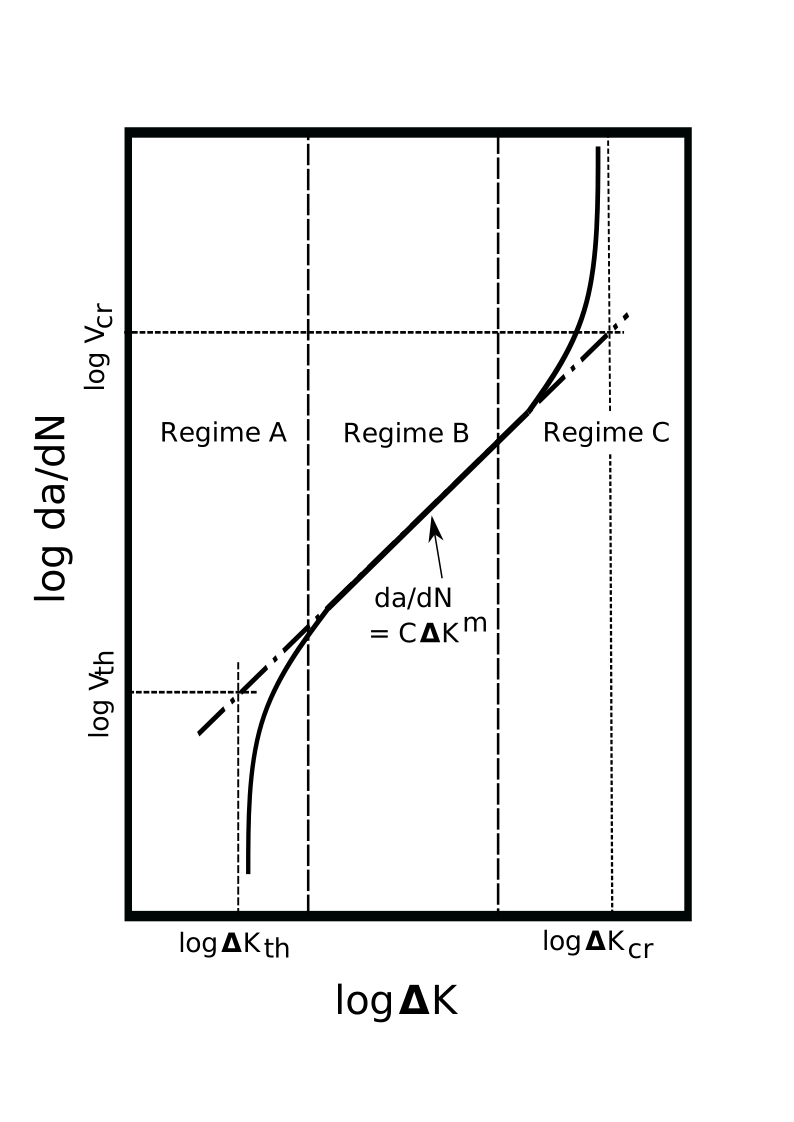
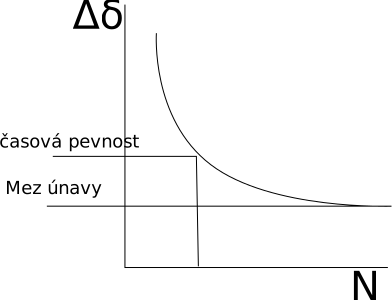
Illustrations (fatigue mechanics)


What failure and performance work produces
- Fatigue design — Detail category, stress ranges, cumulative damage, and inspection planning.
- Fracture / robustness — Special assessments for thick tension members or disproportionate collapse strategies where required.
- Serviceability — Vibration acceptance criteria for floors and footbridges; damping and human comfort checks.
Code basis
Fatigue provisions in steel codes (e.g. SANS 10162 context) reference detail categories and S–N curves. Bridge and machinery projects may use additional standards; performance-based reliability ties to Ch. 12 framing on the Advanced Design Theory page.
Notation (on-page calculators)
- Miner — n applied cycles; N allowable cycles at one stress range; D damage indicator.
- Log–log S–N — S stress range (MPa); C, m line parameters; N cycles.
- Acceleration — f frequency (Hz); x displacement amplitude (mm); a peak acceleration.
Introduction
Bridges, cranes, and slender floors often govern on fatigue or acceleration rather than on ULS bending. Real fatigue design requires stress ranges, detail categories, spectrum loading, and sometimes fracture mechanics. The calculators below are illustrative; hot-spot stress and code S–N data must follow the governing standard.
Fatigue and fracture (handbook themes)
- S–N approach — Stress-life curves for categories of structural detail; variable amplitude and Miner’s rule.
- Fracture mechanics — Crack growth for thick tension members and special assessments.
- Welded details — Toe geometry, residual stress, post-weld treatment; inspection intervals.
Vibration and performance limit states (handbook themes)
- Human response — Acceleration and frequency acceptance criteria for floors and footbridges.
- Harmonic vs random — Walking, machinery, wind; damping assumptions.
- Link to reliability — Serviceability as a limit state with its own target reliability (Ch. 12 context).
Calculators (illustrative)
Miner damage, S–N estimate from a log–log line, and harmonic acceleration from displacement amplitude.
Calculator — Palmgren–Miner damage (single stress range)
Cycles applied vs allowable
Palmgren–Miner damage ratio D = n/N for a single stress range.
Calculator — S–N cycles (log–log line)
log10 N = C − m log10 S
Allowable cycles at stress range S
Cycles to failure N from a log–log S–N line (log10N = C − m log10S).
Calculator — floor peak acceleration (simplified)
Walking / rhythmic excitation screening
Order-of-magnitude acceleration
Peak acceleration from harmonic motion a ≈ 4π²f²x for frequency f and displacement amplitude x.
Software and fatigue / dynamics
Fatigue life prediction, fracture mechanics, and crowd-induced vibration often use specialist software. Examples (official vendor sites):
- SAP2000 — dynamic analysis workflows.
- RFEM — FEA for refined stress fields.
- Autodesk Robot Structural Analysis — analysis and design.
- Strand7 — FEA including dynamics (verify licence and applicability).
No endorsement—fatigue and fracture assessments must follow the governing code detail categories and agreed stress analysis basis.
Diagram sources
Educational schematics. Files in Images/failure-performance-topics/ from Wikimedia Commons.
- Crack propagation curve Paris' law.svg — Sairam Pamulaparthi Venkata; Paris regimes.
- Wohlerova Krivka.svg — Simca; Wöhler (S–N) curve.